
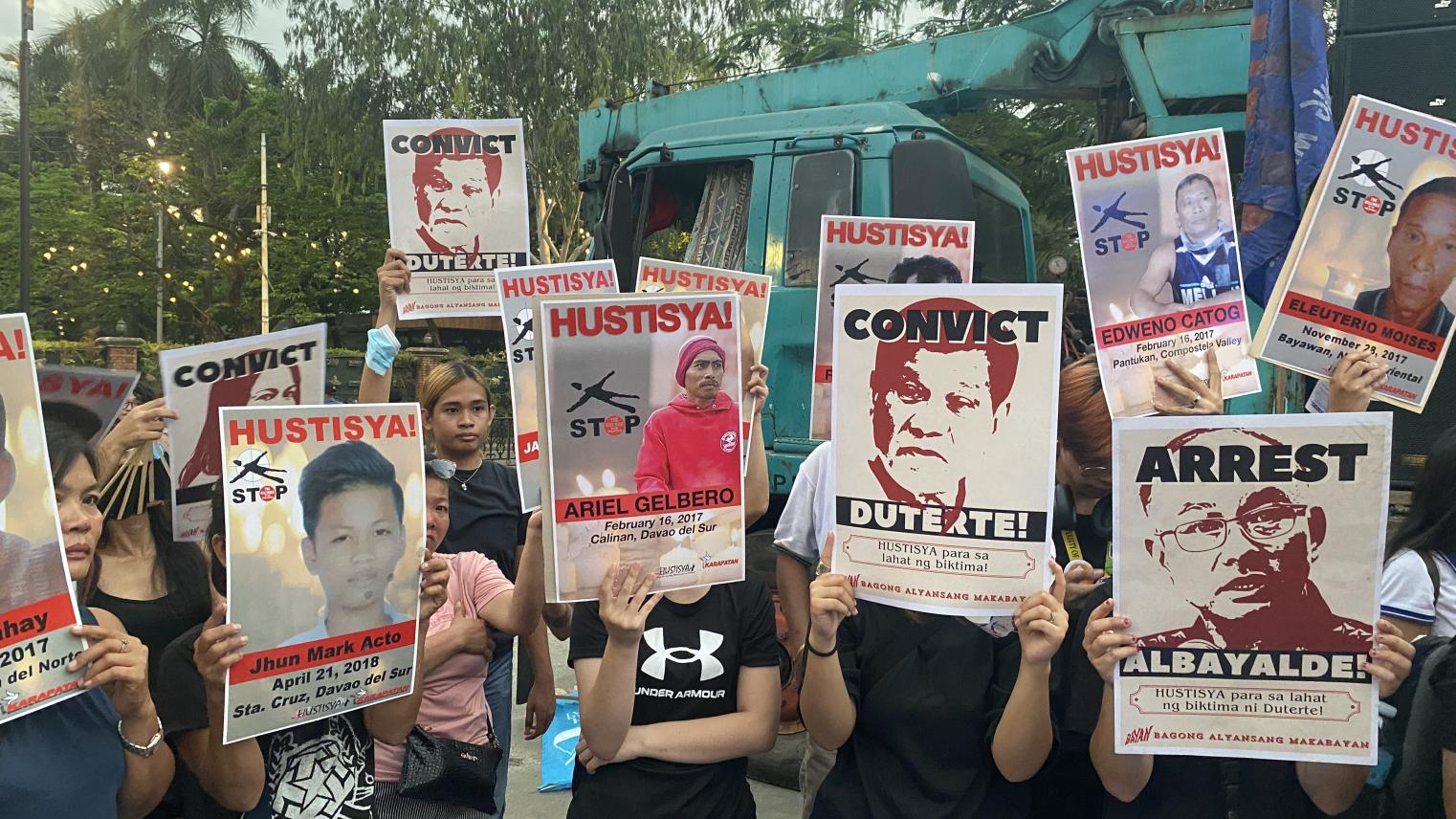
In this lecture, the speaker will discuss how the ICC case of Rodrigo Duterte shapes movements to enhance international accountability and justice.
The ICC case of Rodrigo Duterte and its international justice implications
The journey of drug war victims towards holding former President Rodrigo Duterte to account at the International Criminal Court (ICC) is a rich case study not only on international jurisprudence for crimes against humanity, but also, its implications on movements to enhance international accountability and justice.
The outcome of Duterte's ICC case could have a lasting repercussion on efforts at curbing impunity globally, as he has so far managed to evade trial due to the several political and legal challenges deployed before the Court, notably on the issue of his arrest, jurisdiction, withdrawal and claims to being unfit for trial due to health reasons. Whatever decision the ICC finally renders on these challenges will have an impact on whether repressive leaders throughout the world can escape accountability by withdrawing their countries from the ICC or claiming humanitarian consideration to avoid trial and prison.
The legal and political obstacles attendant to the Duterte case, as well as the victims’ response to these impediments, are a rich field for research by scholars on the interplay of these issues and its consequence for other countries plagued with atrocity crimes veering towards illiberalism and ‘radical populism’. While the ICC remains a viable option in the search for justice, domestic legal system reform remains the most effective means by which victims could achieve justice for human rights atrocities.
About the Speaker:
Neri Colmenares is a leading human rights lawyer and law reformer in the Philippines. He was a key figure pushing for Philippine membership of the International Criminal Court and was among legislators who passed the Philippine Act implementing the Rome Statute. He is currently counsel to drug war victims who have charged former President Rodrigo Duterte with crimes against humanity in the ICC, and will represent them at Duterte’s trial in The Hague. In 2020, Mr Colmenares was awarded the International Bar Association Human Rights Award for 'Outstanding Contribution by a Legal Practitioner to Human Rights' and ‘continuing determination and advocacy, in the face of great adversity’. As a congressman, he was a main author of important human rights laws including the Anti-Torture Law, the Anti-Enforced Disappearance Law and the Reparation Law for human rights violation victims. He has played a central role in anti-corruption movements, and was a public prosecutor in an impeachment trial that convicted the Chief Justice of corruption.
Discussant:
Ruby Rosselle ‘Ross’ Tugade is a doctoral researcher at the Faculty of Law & Justice of the University of New South Wales Sydney, supported by an Australian Government Research and Training Program (RTP) scholarship. Her doctoral project seeks to build an international legal history of anti-communism in the Philippines, weaving critical theories of international law with an analysis of state violence and resistance to it. Prior to commencing her PhD studies, she lectured at the University of the Philippines College of Law and the Ateneo de Manila University. She is licensed to practice law in the Philippines and admitted into the List of Assistants to Counsel of the International Criminal Court, one of eight Filipino lawyers accredited by the court and the youngest so far. She is an affiliate of the ANU Philippines Institute and a casual sessional academic at the ANU Coral Bell School, Department of International Relations.
If you require accessibility accommodations or a visitor Personal Emergency Evacuation plan please contact the event organiser.
